


Many new waterfowl exhibitors are surprised to learn that ducklings don’t finish feathering after they lose their soft baby down. During their first year of life, breeds like Pekins and Cayugas actually develop two sets of feathers before reaching their first complete plumage.
The Feathering Process
As ducklings grow, they go through several stages:
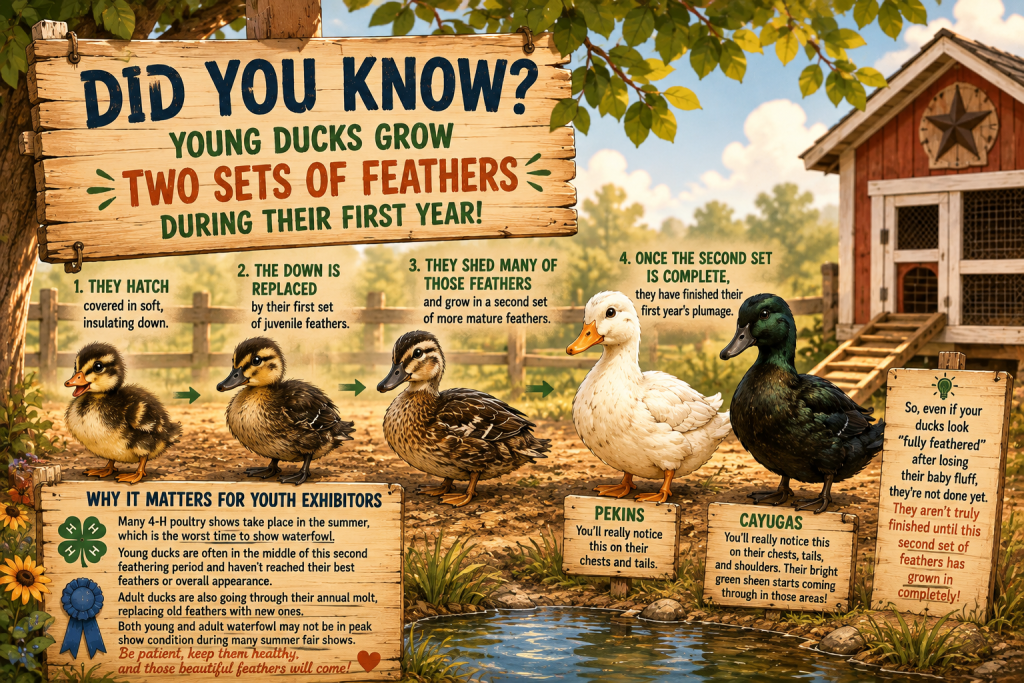
- They hatch covered in soft insulating down.
- The down is gradually replaced by their first set of juvenile feathers.
- Later in their first year, many of those juvenile feathers are replaced as a second, more mature set of feathers grows in.
- Once this second feathering is complete, young ducks have finished their first year’s plumage and typically won’t replace large numbers of feathers again until their normal annual molt.
What to Watch For
Each breed shows this transition a little differently.
Pekins often show the biggest changes across the chest and tail as new feathers replace the juvenile plumage.
Cayugas typically show changes on the chest, tail, and shoulders. As their mature feathers develop, the breed’s characteristic iridescent green sheen becomes much more noticeable.
Because of this second feathering cycle, a duck that appears fully feathered after losing its baby down may still have weeks of development ahead before reaching its best appearance.
Why It Matters for Youth Exhibitors
Understanding this natural feathering process is especially helpful for youth participating in 4-H, FFA, or other exhibition poultry programs.
Many county fairs and junior poultry shows take place during the summer, which often coincides with one of the most challenging times to exhibit waterfowl. Young ducks may still be replacing their juvenile feathers with their first mature plumage, while adult ducks are frequently beginning or progressing through their annual molt.
As a result, both young and mature birds may not display the smooth feather quality, color, or overall finish seen during other times of the year. If your young Pekin or Cayuga looks uneven, patchy, or slightly rough, it doesn’t necessarily indicate poor care or nutrition—it may simply be following its normal feather development.
Recognizing these seasonal changes helps exhibitors set realistic expectations, care for their birds appropriately, and better understand why waterfowl may not always be at peak condition during many summer shows.
This article was written by the Texas Junior Exhibition Poultry Club to provide general educational information for youth waterfowl exhibitors and poultry enthusiasts. We appreciate the many breeders and educators who share their knowledge with the poultry community, including Bucking Duck Ranch LLC, whose educational content helped inspire this article.